How Did Old Tampa Bay Get Its Name?
 0
0
 0
0
The water you see stretching westward from Tampa’s shoreline has a story buried beneath every wave. Old Tampa Bay is one of Florida’s most recognized estuaries, yet most people who live near it, boat on it, or fish its shallow flats have little idea where the name actually came from. The history is messier, older, and more interesting than a quick Google search suggests.
The Geography Behind the Name
Before getting into the naming history, it helps to understand what Old Tampa Bay actually is. The full Tampa Bay system divides into three distinct sub-bays. Old Tampa Bay occupies the northwestern arm, bordered by Pinellas County to the west and Hillsborough County to the north and east. Hillsborough Bay sits to the southeast, and Middle Tampa Bay connects them both.
The “Old” in the name is the key detail. It signals seniority, a designation that marks this section of the bay as the original, the one European explorers and early cartographers identified first. That story starts with the Spanish.
Spanish Exploration and the First Maps
When Spanish expeditions began probing Florida’s Gulf Coast in the early 1500s, they needed names for the bodies of water they encountered. The bay system now called Tampa Bay appeared on Spanish maps under several early labels, including “Bahia Honda” (deep bay) and various phonetic adaptations of indigenous place names.
The name “Tampa” itself almost certainly derives from the language of the Tocobaga, the native people who inhabited the shores of this bay system for centuries before European contact. Linguists and historians have proposed several interpretations, with “Tampa” possibly meaning “sticks of fire” or referencing a nearby village. The exact translation remains disputed, but the indigenous origin is well established.
Early Spanish maps were inconsistent. Different expedition cartographers applied the Tampa name to different parts of the bay, which created geographic confusion that persisted for generations.
Why “Old” Tampa Bay Specifically?
As Tampa grew through the 19th century and American settlers pushed into the region, the full bay system needed clearer subdivision for navigation, commerce, and land surveys. The northwestern arm, which had the longest recorded history of European observation and charting, received the “Old” designation to distinguish it from the more recently named and commercially developed Hillsborough Bay to the southeast.
Think of it the way towns get “Old Town” districts. The label preserves historical precedence. Old Tampa Bay was the portion that appeared on the earliest reliable charts, the water Spanish sailors and later American surveyors first put a firm name to.
Port Tampa, established in the 1880s along its southern shore, added commercial weight to the area’s identity. The Plant Investment Company extended Henry Plant’s railroad network to Port Tampa in 1888, making Old Tampa Bay a working waterway tied to phosphate shipping and passenger travel. That industrial heritage reinforced the sense that this was the original, foundational part of the broader bay system.
The Tocobaga Connection
The Tocobaga people deserve far more credit in this story than they typically receive. They occupied the shores of Old Tampa Bay for at least 1,000 years before Spanish contact, building shell midden mounds that still exist at Philippe Park in Safety Harbor. Safety Harbor itself sits at the northeastern tip of Old Tampa Bay, and the Safety Harbor archaeological site is considered a defining location for the Tocobaga culture.
Spanish explorer Hernando de Soto landed somewhere along Tampa Bay in 1539, with Safety Harbor area cited by many historians as the probable landing point. That landing placed European boots directly on the shores of what would become Old Tampa Bay, and the indigenous place names from that encounter fed directly into the Spanish maps that eventually gave the bay its lasting identity.
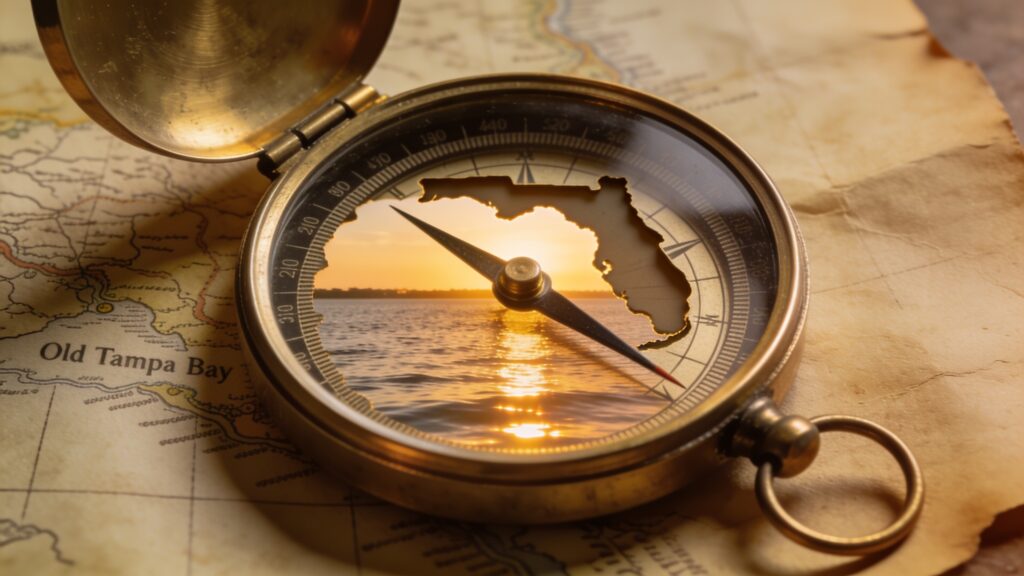
Key Timeline of the Naming History
| Year | Event |
|---|---|
| Pre-1500s | Tocobaga people inhabit Old Tampa Bay shores |
| 1513 | Juan Ponce de Leon charts Florida’s Gulf Coast |
| 1539 | Hernando de Soto expedition lands near Tampa Bay |
| 1757 | Spanish maps begin consistent use of “Tampa” for the bay system |
| 1824 | Fort Brooke established, anchoring Tampa’s permanent American settlement |
| 1888 | Port Tampa opens on Old Tampa Bay’s southern shore |
| Late 1800s | “Old Tampa Bay” adopted as standard sub-bay designation |
What Makes the Name Stick Today
Several factors have kept “Old Tampa Bay” firmly in the geographic vocabulary.
- The bay’s ecological significance as a protected estuary with seagrass beds, mangrove shorelines, and bird rookeries gives it ongoing scientific and environmental attention.
- The Tampa Bay Estuary Program actively monitors water quality and habitat restoration across the sub-bays, with Old Tampa Bay receiving specific attention because of historical pollution from agricultural runoff.
- Recreational boaters and anglers use the sub-bay names daily for navigation and fishing reports.
- Local media, including sites covering Tampa Bay news, reference Old Tampa Bay as a distinct location with its own weather patterns, water conditions, and events.
The name has earned its permanence through continuous, practical use across centuries.
The Bigger Picture
Place names carry layers. “Old Tampa Bay” tells you something about European exploration, indigenous geography, 19th-century commercial development, and the need to organize a sprawling waterway into navigable sections. None of those layers cancel the others out.
The Tocobaga gave the bay its foundational name. The Spanish mapped it and applied that name to paper. American settlers subdivided it and stamped “Old” onto its oldest-known section. Each group added a layer that the name still holds.
Key Takeaways
Old Tampa Bay carries a name built from indigenous language, Spanish cartography, and American settlement patterns. The “Old” designation reflects historical precedence, marking the northwestern arm as the first-charted section of the broader Tampa Bay system. The Tocobaga people’s presence on its shores predates European naming by centuries, and their place names fed directly into the Spanish maps that shaped everything that followed.
If you spend time on this water, it rewards a second look at the history beneath the surface. Explore the shell midden mounds at Philippe Park, read up on the Tocobaga, and the next time someone asks how Old Tampa Bay got its name, you will have a real answer ready.